
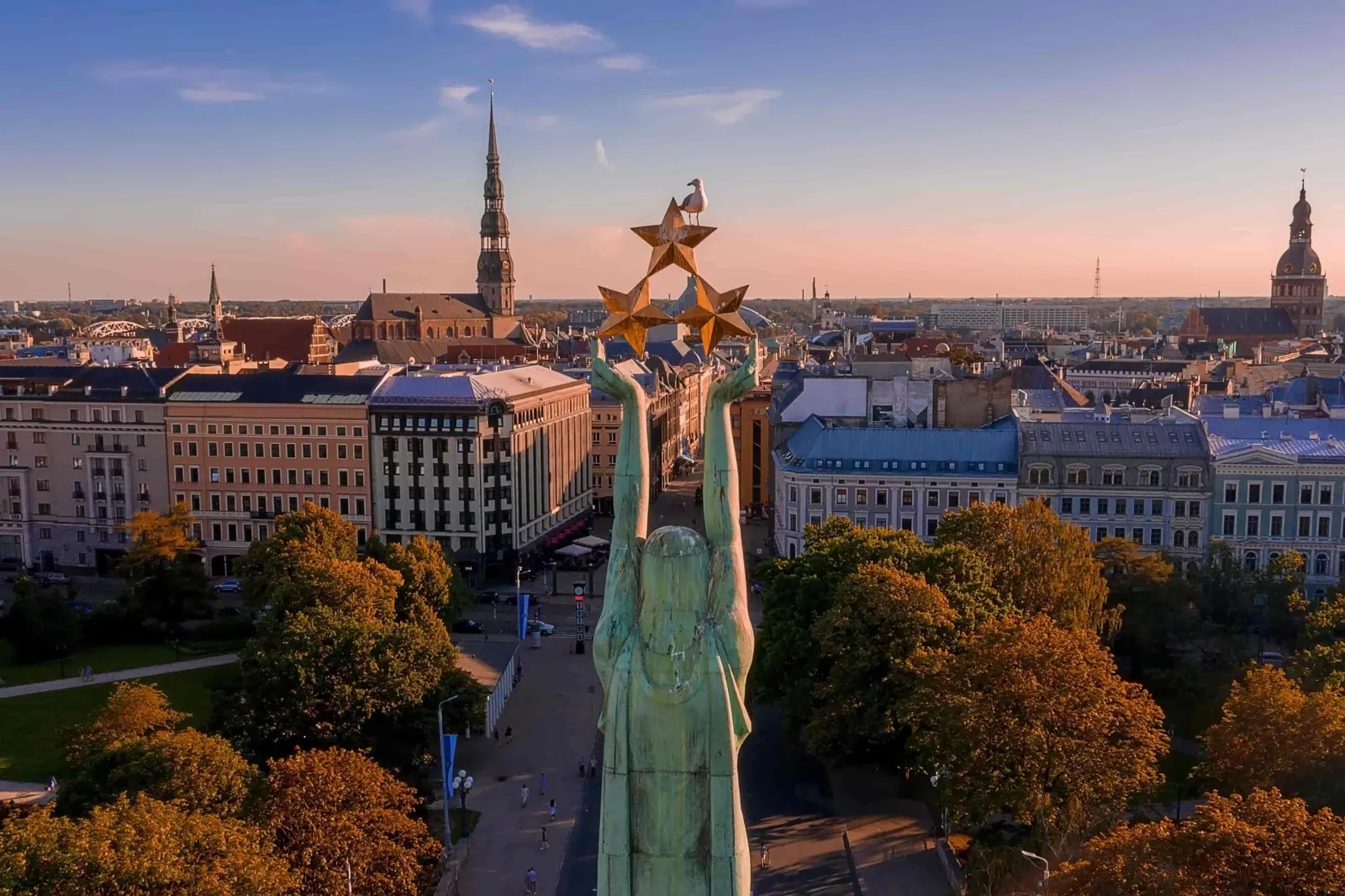
Latvia’s familiar images include Riga’s church towers, forest roads and Baltic beaches. Looking a little closer brings together food, language, science and stories that have travelled far beyond the country. These 30 facts about Latvia offer a broad introduction, with a distinction between history, legend and claims that need context.
1. Forests cover a large share of the country
Around half of Latvia is forested. That helps explain the woodland visible on journeys between towns, although managed forest, protected habitat and untouched wilderness are different things.
2. Rye bread has a place beyond the bread basket
Rupjmaize, dark rye bread, accompanies many Latvian meals. Rye bread also appears in desserts, including layered preparations with cream and fruit or jam.
3. Riga-born Jacob Davis helped create riveted jeans
Jacob Davis and Levi Strauss received their US patent for reinforcing trousers with rivets in 1873. The innovation concerned the construction of work trousers, rather than the invention of denim fabric itself.
4. Riga has several historic layers
The UNESCO-listed Historic Centre of Riga includes medieval streets, boulevards and later neighbourhoods. Its Art Nouveau buildings belong largely to the city’s expansion around the beginning of the twentieth century.
5. A height study gave Latvia a memorable result
A 2016 global study placed Latvian women born in 1996 at the top of its height comparison, around 170 centimetres on average. That is a finding about a defined cohort, not every individual or every generation.
6. Kuldīga is known for a very wide waterfall
Ventas rumba crosses a low rocky step in the Venta River. Its width and changing water levels, rather than a dramatic vertical drop, give it its distinctive appearance.
7. The flag has a medieval reference
The dark red-and-white national flag is linked with a banner described in the Livonian Rhymed Chronicle. A separate story about a wounded leader and a bloodstained cloth belongs to legend.
8. Courland had a short colonial presence overseas
The seventeenth-century Duchy of Courland and Semigallia established outposts in Tobago and the Gambia. This predates modern Latvia and belongs to the wider history of Atlantic colonialism.
9. The Song and Dance Celebration is a major tradition
Latvia’s nationwide celebration normally follows a five-year cycle. The shared Baltic song and dance tradition is recognised by UNESCO as intangible cultural heritage.
10. Rivers and lakes shape travel beyond Riga
The Daugava, Gauja and Venta are among the rivers visitors encounter. Routes along water can involve different access and safety conditions, so local information matters when planning a walk or paddling trip.
11. Digital connections are part of modern Latvia
Internet infrastructure is important to daily life and international businesses. Connection quality still depends on the address and service, so an old global speed ranking cannot guarantee the connection at a particular rental.
12. Latvian belongs to the Baltic language group
Latvian and Lithuanian are closely related Indo-European languages. Estonian belongs to the Finnic group, despite Estonia also being one of the three Baltic states.
13. Midsummer traditions remain visible
Līgo and Jāņi fall on 23 and 24 June. Wreaths, singing, seasonal food and bonfires are familiar elements, with customs differing between families and events.
14. Regional histories predate the modern republic
Curonians, Semigallians and other Baltic peoples appear in the history of the territory. Their names and past should not be treated as interchangeable with the citizenship of a present-day state.
15. Riga Black Balsam is a familiar local spirit
The dark herbal drink is associated with Riga and has a long commercial history. Stories about healing belong to its folklore and marketing history, not evidence that drinking it treats illness.
16. Juris Upatnieks helped develop practical holography
The Riga-born engineer worked with Emmett Leith at the University of Michigan on important developments in display holography. Their work was part of a broader scientific history rather than one isolated invention.
17. The capital has a large role in national life
Riga concentrates many of Latvia’s jobs, universities and cultural institutions. Its experience is not a substitute for visiting regional towns, whose scale and daily routines can be quite different.
18. Nature is accessible in several forms
Latvia has coast, forests, wetlands and cultivated countryside. The condition of air or water varies by place and time; a green landscape alone is not proof of a nationwide environmental record.
19. Aleksandrs Laime is connected with Angel Falls
The Latvian-born explorer took part in journeys around Venezuela’s Angel Falls, including Ruth Robertson’s 1949 expedition. Saying that he simply “discovered” a landscape already known to Indigenous people would leave out important context.
20. Mark Rothko was born in present-day Daugavpils
The artist was born in 1903 in the city then known as Dvinsk. Daugavpils now has a Rothko Museum that connects his birthplace with his wider artistic legacy.
21. Ice hockey has produced a major sporting milestone
Latvia won bronze at the 2023 men’s IIHF World Championship, its first medal in that tournament. Ice hockey has a strong following, alongside other popular sports.
22. Riga has a celebrated Christmas-tree story
The city associates a decorated Christmas tree with 1510. Claims about the very first tree depend on definitions and competing traditions, so the local story is best presented with that qualification.
23. Summer evenings are long
Latvia’s northern latitude produces long daylight hours around midsummer. This is not polar midnight sun: the sun still sets, and winter brings a very different balance of daylight.
24. The bathhouse is called pirts
Pirts refers to a bathhouse and its associated traditions. Heat, steam, plants and an experienced attendant can form part of a visit, though practices differ between hosts.
25. University funding is not the same for everyone
Latvia has state-funded study places and fee-paying programmes. International applicants should check the fee and eligibility for their exact course instead of assuming that all university education is free.
26. Fermented and preserved foods are familiar
Kefir, sauerkraut, pickles and other preserved products appear in Latvian food culture. Recipes and ingredients vary, so ask about preparation if you have dietary restrictions.
27. “Baltic Tigers” describes an economic period
The phrase became associated with rapid growth in Latvia, Estonia and Lithuania in the 2000s. It is a historical label, not a guarantee about present growth, wages or investment returns.
28. Latvia won Eurovision in 2002
Marie N won with “I Wanna” at the contest in Tallinn. Latvia subsequently hosted the 2003 contest in Riga, giving the competition a particular place in its popular-music history.
29. Riga has a contemporary street-art scene
Murals and installations offer routes beyond the best-known historic sights. Works and access can change, so use current neighbourhood information when setting out to find a particular piece.
30. Name days are part of the calendar
Latvian name days associate first names with dates. Flowers, greetings or shared cake can mark the occasion, although how much people celebrate depends on the person and family.
Use these details as starting points for a visit or a conversation. A museum, a market stall or a local celebration will usually add more than a record-style claim on its own. The country becomes easier to understand when the broad description is connected with a particular person, place or tradition.