
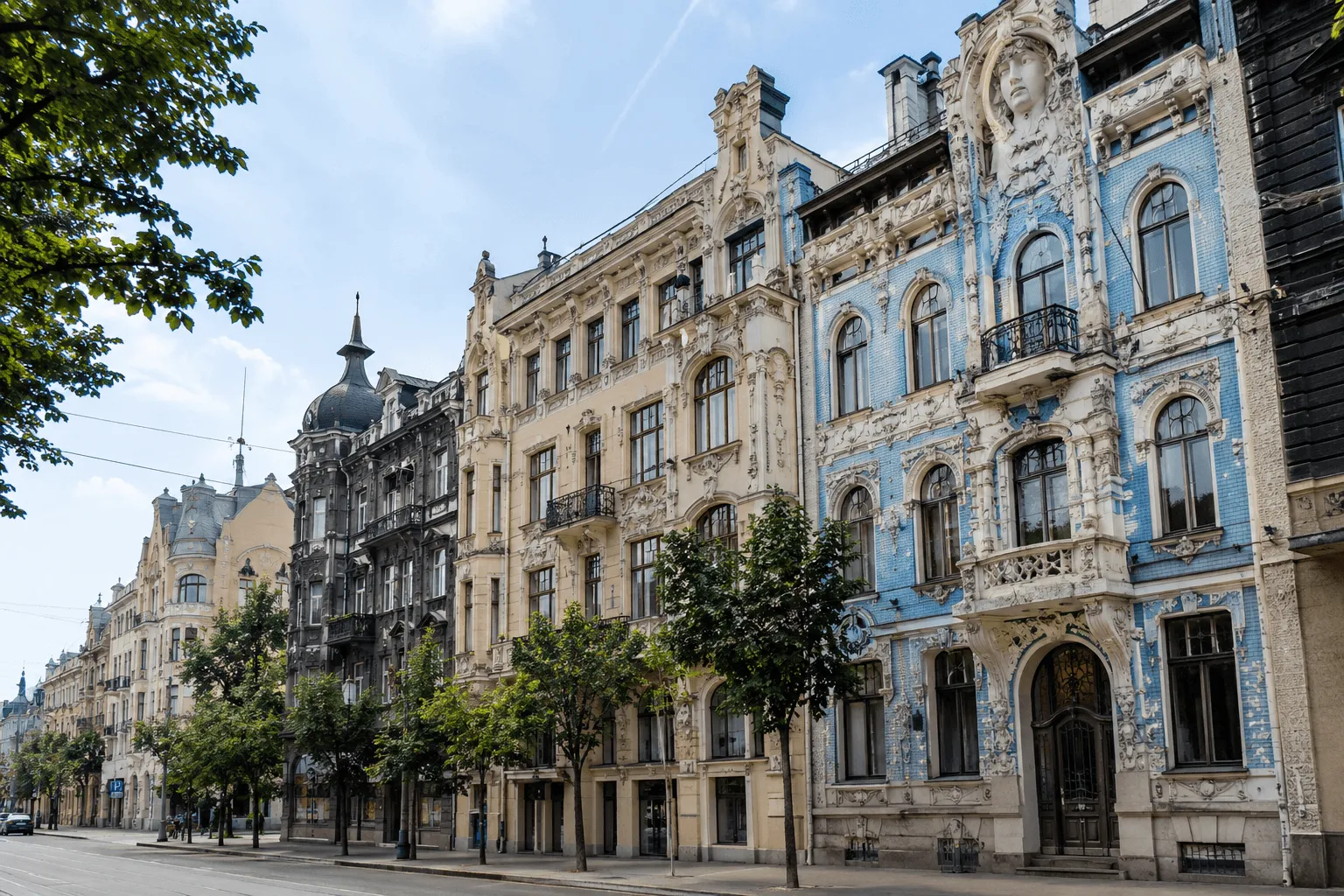
Walk through central Riga and it is difficult to miss the faces looking down from the buildings. Some facades have sculpted figures and curling plants; others rely on tall windows, geometric patterns and carefully arranged brickwork. These are different expressions of Art Nouveau architecture in Riga, a style that spread through the city during a period of rapid growth.
The explanation for their concentration begins with timing. Riga needed new homes and commercial premises just as European architects were experimenting with a new visual language. The result survives across whole streets of apartment buildings, especially beyond the medieval Old Town.
A growing city needed room
Riga had long benefited from its position on the Daugava and its Baltic trading connections. During the nineteenth century, industrial development brought further investment and population growth. The old centre, with its narrow streets and existing buildings, could not absorb every new household and business.
New districts spread outside the medieval core. Boulevards, parks and regular street blocks created space for larger buildings. Owners commissioned apartment houses that could accommodate tenants while giving a newly developing neighbourhood an attractive address. This explains why so much of the city's architectural character belongs to everyday residential buildings.
That construction boom overlapped with the rise of Art Nouveau around the turn of the twentieth century. Architects working in Riga adopted the movement while responding to local clients, materials and ideas. A large amount of building took place within a relatively short period, giving the style a strong presence in the streetscape.
What Art Nouveau looks like here
Art Nouveau, also known as Jugendstil in this part of Europe, developed through several approaches. Flowing lines and botanical decoration are familiar features, but they are only part of the story. Sculpted masks, unusual window shapes, animal figures and abstract ornament also appear on Riga's facades.
Some buildings are theatrical enough to hold your attention from the opposite pavement. Others reveal their character through restrained details around a doorway or a sequence of windows. Looking at several neighbouring houses helps: the differences become clearer when there is a point of comparison.
Later designs could be more geometric, while National Romantic interpretations drew on local traditions and materials. There was no single template that every architect followed. This variety is one reason a walk through the district rewards more time than a quick photograph of one famous facade.
Alberta iela and the architects behind it
Alberta iela is a useful starting point for visitors. Its concentration of early twentieth-century buildings makes it possible to study several approaches within a short walk. Nearby Elizabetes iela and the surrounding streets extend the route.
Mikhail Eisenstein is closely associated with Riga's elaborate decorative facades. His buildings help explain the city's reputation for expressive masks and sculptural ornament. However, the wider collection also includes major work by Konstantīns Pēkšēns, Eižens Laube and other architects. Reducing the district to one designer misses much of what makes it interesting.
The Riga Art Nouveau Centre, at Alberta iela 12, offers a different perspective through an early twentieth-century apartment interior. Street views show how owners presented their buildings to the city; an interior gives a sense of the domestic setting behind those facades. Check the museum's current visiting arrangements before planning your day.
Why apartment buildings received so much attention
A decorative facade helped a property stand out in a competitive urban neighbourhood. It could suggest prosperity, craftsmanship and a fashionable address. Windows, entrances and balconies were therefore part of the owner's public presentation as well as practical components of a home.
Because the style was widely used for apartment houses, it shaped entire blocks. You encounter it between shops, offices and occupied homes. Many of these buildings remain part of daily city life, so remember that an impressive doorway may still be somebody's front entrance. Admire it from public space unless access is explicitly offered.
Seeing the city beyond one street
Riga's historic centre received UNESCO World Heritage status in 1997. Its architectural interest includes the medieval core, the boulevard district, wooden buildings and the remarkable concentration of Art Nouveau. These layers are easier to understand together than as isolated attractions.
Start in the Old Town, cross the park and canal area, then continue into the streets around Alberta iela. The changing scale of the buildings makes the city's expansion visible. Allow time to look upwards, but keep an eye on crossings and cyclists when stopping for photographs.
The answer to why Riga has so many Art Nouveau buildings is written in that route: a trading and industrial city expanded at the moment a new architectural movement became fashionable. New neighbourhoods gave architects room to work, and residential construction gave the movement a much wider reach than a handful of monumental buildings could have done.