
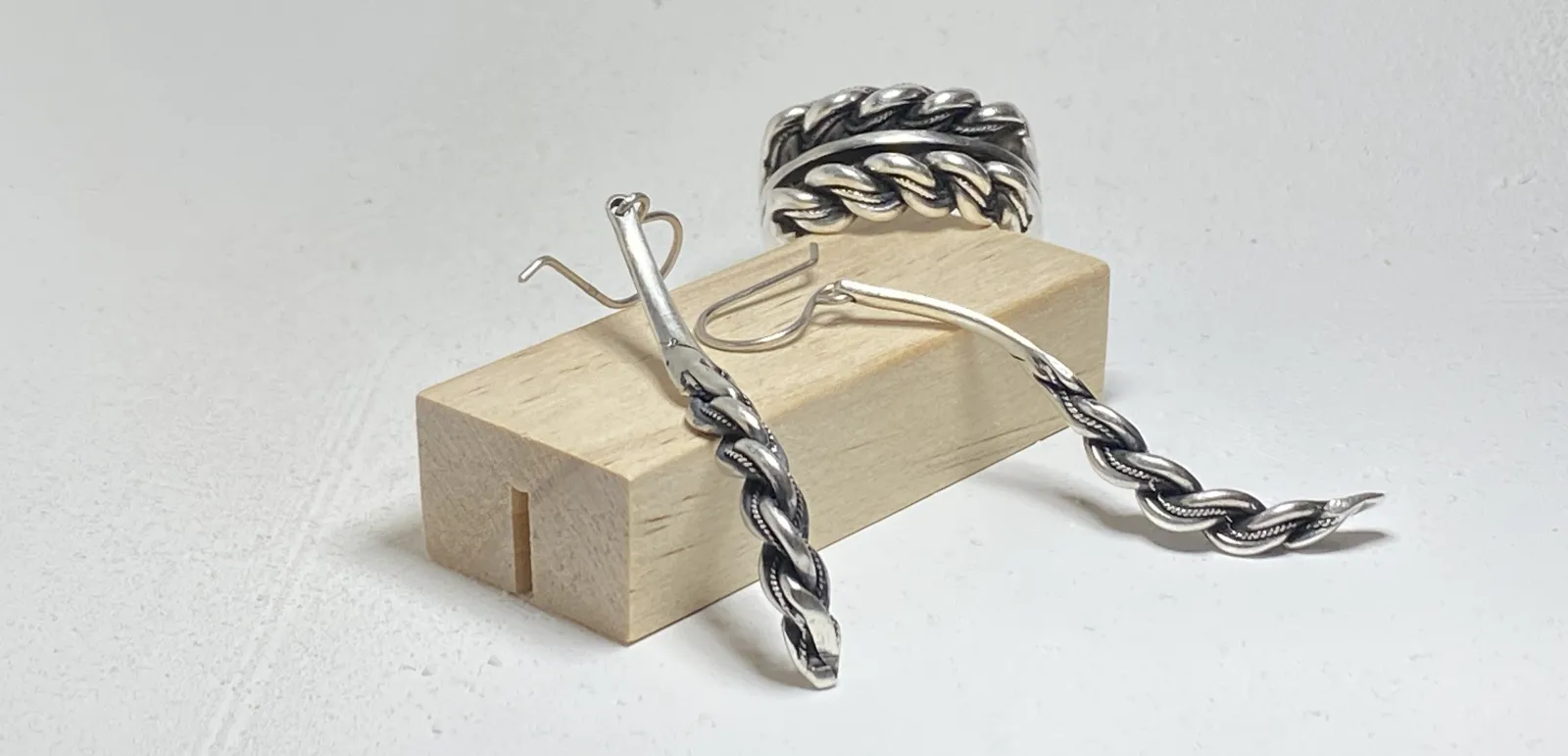
The Namejs ring is one of Latvia's most recognisable pieces of jewellery. Its interwoven bands create a substantial, textured ring, usually in silver. In Latvian it is called Nameja gredzens, and its meaning reaches beyond its appearance: people associate it with belonging, loyalty, friendship and trust.
You may notice it in a jeweller's window in Riga or on the hand of someone with Latvian family ties. Understanding the ring means keeping two stories in view. One is the archaeological history of braided rings. The other is the legend attached to the medieval leader Namejs.
The legend of Namejs and his son
Namejs was a thirteenth-century Semigallian leader associated with resistance to the Livonian crusaders. In a familiar version of the story, he leaves a distinctive ring with his son before departing. The ring is intended to help them recognise each other when they meet again.
When enemies learn of the ring, the boy becomes vulnerable. Other men and boys begin wearing similar rings, making it impossible to single him out. The design becomes a sign of solidarity, and the danger faced by one family is answered by a wider community.
Another version connects the rings with Namejs and his followers withdrawing to Lithuania. Here, the jewellery marks friendship and mutual trust. The details vary between retellings, which is a reason to present these accounts as legends rather than a documented sequence of events.
What archaeology can tell us
Braided rings of this kind have a history independent of the famous tale. Medieval examples have been found in the eastern Latvian region of Latgale, and the form is associated with material older than the later public image of Namejs wearing his ring.
There is no established evidence that the historical leader invented the design or owned a particular surviving example. A ring can have an old physical form and a more recent name. That distinction helps explain how an archaeological object became a widely recognised cultural symbol.
The association grew during the twentieth century. Aleksandrs Grīns's 1928 novel Nameja gredzens helped bring the story to a broader audience. Later illustrations, jewellery making and popular culture continued to connect the braided ring with the leader. The film The Pagan King, released in 2018, offered another fictional retelling.
Reading the braided design
A classic Latvian Namejs ring has several strands woven around one another. Contemporary versions range from fairly simple bands to intricate work with smaller twisted wires between the main elements. Silver is familiar, though gold, bronze and mixed-metal examples also exist.
The interlocking strands are often explained as a symbol of unity. Some accounts connect them with Latvia's historical regions; others emphasise family, friendship or the relationship between individuals and their community. These are cultural interpretations, and there is no single compulsory meaning that every wearer must adopt.
Likewise, the number of strands in a modern piece should not be treated as a fixed historical code. Designs differ between makers. Ask the craftsperson about the particular ring if its symbolism matters to you.
Craftsmanship and everyday wear
Traditional production involves shaping and twisting metal wires, weaving them together and joining the band. The quality of the finish affects how the ring feels against neighbouring fingers and how easily it catches on clothing. Contemporary manufacturing methods vary, so do not assume every ring with the same appearance was made entirely by hand.
Try a wide ring on before buying it where possible. A broad braided band can feel different from a narrow wedding band in the same stated size. Check the inside surface, the joins and the edges, and ask about resizing before committing to a fit.
The ring has often been associated with men and with gifts marking adulthood. Today it is worn by people of different genders and ages. For some, it is a family gift; for others, a connection with Latvia or an appreciation of local metalwork.
A small object with a public presence
The design also appeared on a Latvian one-lats circulation coin issued in June 2009, before Latvia adopted the euro in 2014. Its appearance on money shows how familiar the ring had become within the country's visual culture.
If you choose one while visiting Latvia, compare the metal, workmanship and maker's explanation rather than relying on a dramatic story alone. The most useful conversation may be about the piece in front of you: who made it, how it was finished and why its design was chosen. That gives the ring a personal history alongside the legend already attached to its name.