
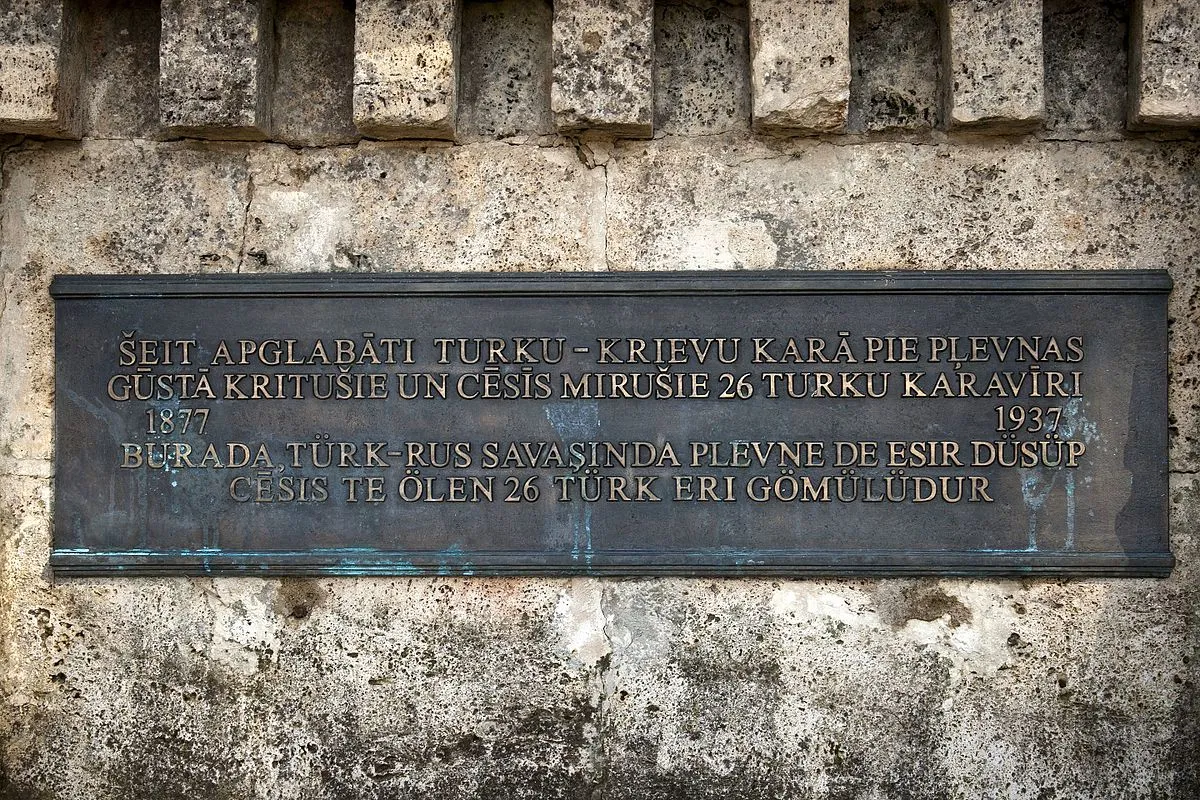
Among the historical places in Cēsis is a cemetery that connects Latvia with the Ottoman Empire. It commemorates soldiers brought to the region as prisoners during the Russo-Turkish War of 1877–1878. Their graves are far from the battlefields and homes with which their story began.
For visitors unfamiliar with this connection, the Turkish Cemetery in Cēsis offers a reason to look beyond the town's medieval landmarks. It is a place of burial and remembrance, with a history shaped by war, captivity and later efforts to preserve the soldiers' memory.
How Ottoman prisoners came to Latvia
During the war of 1877–1878, the Russian army captured Ottoman soldiers and transported some prisoners to territories that are now part of Latvia. At that time, Latvia was not an independent republic; the territory belonged to the Russian Empire.
The conflict is often called the “93 War” in Turkish historical usage, referring to the Ottoman calendar. A visitor reading that term in Turkish material should therefore not mistake it for a war in 1893.
The soldiers commemorated in Cēsis died after their captivity, with wounds and disease forming part of the account preserved by the Turkish embassy. The cemetery inscription connects them with capture at Plevna, now Pleven in Bulgaria. The memorial places a distant military campaign within the history of an ordinary Baltic town.
The twenty-six soldiers
According to the Turkish embassy's record, 26 soldiers are buried at the site. Stones bearing the star and crescent symbol represent the graves, while the central memorial carries an inscription in Turkish and Latvian.
The bilingual inscription is part of what makes the site understandable across national backgrounds. It identifies the dead and the circumstances commemorated without requiring visitors to share a nationality or religious practice. Reading it slowly is a useful way to begin a visit.
Numbers and details can differ in older retellings. The embassy's account and the surviving memorial provide a clearer basis than treating every local anecdote as a documented fact. The soldiers' individual experiences should not be filled in with imagined diaries or conversations.
Preserving the cemetery
The memorial took its established form in 1937, following an initiative associated with the Turkish diplomatic representation accredited to Latvia. Later cooperation between Turkish and Latvian institutions supported maintenance and restoration.
A maintenance and restoration protocol was signed in 2004, and the restored cemetery was formally inaugurated in September 2005. These later dates are part of the site's story: what visitors see reflects preservation work as well as the original burials.
Commemorative ceremonies have also brought the site into the continuing relationship between Latvia and Türkiye. They do not change its central purpose as a resting place for people who died far from home.
Planning a respectful visit
Use current local information to find the cemetery and confirm access. Do not rely on a literary description of a forest path as precise directions. If arriving by public transport, plan the onward walk and return journey separately from the trip to central Cēsis.
At the cemetery, keep to accessible paths and leave grave markers, inscriptions and flowers undisturbed. If a ceremony or a private act of remembrance is taking place, give those involved space. Ask before photographing people, and avoid posing on graves or using the memorial as a prop.
Visitors may choose to pray, stand quietly or simply read the inscription. No particular personal response is required. An informed and considerate visit is possible from any cultural or religious background.
Seeing Cēsis with a wider historical perspective
Cēsis is often visited for its castle and older streets. Including the cemetery broadens that picture to the nineteenth century and to the movement of people under imperial rule. It also shows how a local place can preserve a connection with events well outside Latvia.
Allow a little time after visiting rather than placing it between hurried photo stops. The significance is in the recorded lives and deaths, the distance from the soldiers' homes and the continuing decision to care for their memory. Those facts are substantial enough without adding a dramatic scene that cannot be verified.